
Finding Bristol Township Resident Records
Records used to locate Bristol Township residents are held by different custodians because each record answers a different question. The Bucks County property form is the strongest first stop for a parcel, an owner name, or a mailing contact. A deed index can then test a title trail. An individual who needs to confirm registration has a separate state status form, while a known court case belongs in the Unified Judicial System docket search. Old addresses need local-history collections, not a current tax screen.
Keep the result narrow. Property and deed material can establish an ownership or transaction link, but neither is a list of everyone who stayed at an address. A voter status response is not a public street roster. A directory entry is evidence for the printed year and its stated geography. Matching the name, address, date, municipality, and source type prevents a Bristol Borough result, a Levittown postal label, or a similar name from being treated as a Bristol Township resident record.
- Enter the known address or surname in the Bucks County Tax Claim property-information form and note the parcel number, location address, municipality, and owner-information fields.
- Use the parcel and current owner as anchors, then check the Recorder of Deeds index for a dated land transaction when title history matters.
- For a specific person, use the state voter-status form or a known UJS docket only for the limited fact each official system is designed to confirm.
- For an earlier family or address question, compare a directory year with newspaper, probate, census, cemetery, or archive material.
- When a particular Township executive record is not online, request the existing file by address, date range, and document type through the proper records officer.
Note: A name match becomes useful only after a second, independent Bristol Township record agrees on the date or place.
Bristol Township Resident Records Offices
Bristol Township itself is not the county seat, so the central property, deed, probate, and court desks are in Doylestown. The Township keeps its own Planning, police-records, council, and administrative material. County offices keep the broad land and court trail. State systems hold registration status and statewide birth and death records. Choosing the custodian first saves time, especially when a request is for a specific document rather than a general search.
Bucks County Recorder of Deeds
55 E. Court Street, 6th Floor
Doylestown, PA 18901
215-348-6209
Bucks County Property Information
Tax Claim property-search routing
Doylestown, PA county services
Current parcel and owner search
Pennsylvania Voter Services
State registration-status route
Pennsylvania statewide service
County office fallback is published by PA Vote
The street-by-street use of the parcel and Recorder systems is kept on the Bristol Township street directory page. The cards above are starting desks, not claims that one office keeps every resident record.
Bristol Township Property Roll Keys
The county’s live Tax Claim form is built around a physical parcel and its tax information. It accepts a parcel number, location address, municipality, name, mailing address, city, and ZIP code. A location search should use a house number and street name only. A name search is entered last-name first. Select Bristol Township where the form allows it, because postal labels such as Bristol, Levittown, Croydon, Fairless Hills, and Newportville do not by themselves settle the municipality.
| Property-form field | How it narrows a Bristol Township search | Important limit |
|---|---|---|
| Parcel Number | Uses the county parcel key; retain dashes. | It identifies land, not every resident. |
| Location Address | Enter house number and street name only. | A street label can cross postal communities. |
| Municipality | Choose Bristol Township to reduce false matches. | It is different from a mailing-city field. |
| Name and Mailing Address | Can locate owner information and correspondence routing. | Mailing contact is not proof of presence at the parcel. |
| ZIP Code | Filters the property form by postal code. | It is not a title or boundary key. |
- Parcel
- A county identifier for a particular tract or unit used in tax and map systems.
- Situs or location address
- The physical address assigned to the parcel, distinct from a correspondence address.
- Legal description
- The land description used in title records, often more durable than a changing street label.
- Index
- A finding aid that points to a record, not always the record image or a complete account.
Bristol Township Deed Name Trail
The Recorder of Deeds holds Bucks County land records from 1684 to the present, but its older research method is party and year based. The office calls the seller or grantor the direct party and the buyer or grantee the indirect party. A full party name and an approximate transaction year are the practical starting keys. The historic index books are divided into published time bands, while the newer indexes are computerized. LANDEX is the county’s fee-based online research route; the public research area and copy-request channels remain useful when a web search does not answer the question.
The most valuable backward-title clue is the recital, often called the being clause, after the legal description in a deed. It gives an earlier book and page or instrument reference. Repeat that reference from deed to deed. The method follows title, not occupancy, and a deed does not reliably date a structure. Compare the title trail with a directory, tax record, permit file, newspaper, or probate source when an earlier family record needs testing.
Recorder access channels. The office offers research terminals and historic index books, fee-based LANDEX, telephone or mail copy requests, and a free deed copy by email for an owner. Use the channel that fits the known reference.
Note: LANDEX availability is a research route, not a promise that an address or every historic image can be found with one simple query.
Bristol Township Voter Access
Pennsylvania provides an individual-facing registration-status service with a county-office and telephone fallback. It is not the same thing as a reusable public list. The state’s voter-list request process has separate forms, identification, an affirmation, costs, and legal limits. Public, street, walking, and full-export products have different fields and permitted uses under 25 Pa.C.S. §§ 1207 and 1404.
That split matters when a street or block is the only known fact. The individual form is for a person’s own status. Address-oriented list material is obtained by the regulated request channel, not by attempting to turn a public status tool into a roster. The state form also prohibits the public internet posting described in its conditions. Use a documented public-record access route and respect the limits placed on the product.
Bristol Township Court Docket Checks
Bristol Township is served through Bucks County’s Court of Common Pleas and Magisterial District Court system. The statewide Pennsylvania UJS Case Information service provides public docket-sheet and calendar access for its stated court categories. A name or docket is a way to verify a known case, court, or event. It is not a complete biography and does not establish current residence by itself. Narrow the search to Bucks County when the workflow offers that choice, and corroborate a similar name with another non-sensitive source.
Public access has boundaries. Secure docket content requires a login, and juvenile, expunged, limited-access, sealed, adoption, and sensitive family records can be unavailable. For estate, marriage-license, and Orphans’ Court questions, use the Bucks Register of Wills and Clerk of Orphans’ Court web-viewer or counter rather than assuming that a criminal docket search covers those files. Give the clerk a case number, division, party name, and document date when requesting a particular record.
Current Bristol Township Resident Sources
No official Bristol Township public index combines all of the sources below. Each row is a separate record trail with a different subject and access rule. That division is useful: use a parcel form for a current ownership question, a state status form for an individual registration question, a recorder index for title parties, and the Township directory only for current public staff contacts.
| Resident-related source | What it can establish | Custodian | Access path |
|---|---|---|---|
| Tax Claim Property Information | Parcel, location, owner and separate mailing filters. | Bucks County | Current online form. |
| Recorder index and instruments | Named parties, land transaction, legal description, and prior reference. | Recorder of Deeds | LANDEX, counter, or copy request. |
| Registration status | An individual’s registration-status check. | Pennsylvania Vote | Online form or county-office route. |
| Township staff directory | Named departments and public personnel contacts. | Bristol Township | Official municipal directory. |
| Grundy local-history holdings | Older directories, newspapers, yearbooks, cemetery and archive leads. | Grundy Library | Collection, catalog, and research inquiry. |
A one-person verification takes a different path from a parcel question. The Bristol Township resident lookup page focuses on that name-first work without treating any one record as a full answer.
Bristol Township Request Routes
The Pennsylvania Right-to-Know Law, 65 P.S. §§ 67.101–67.3104, is a route to existing executive-agency records, not a request for an office to create a resident list or perform research. A focused request identifies the document, address or person as appropriate, date window, department, and whether inspection or copies are wanted. Bristol Township’s Planning files, permit material, and administrative records follow the Township’s Right-to-Know route. County executive material follows the county process. Recorder copies, court files, and judicial-row-office material use their own procedures.
The Office of Open Records supplies the standard RTKL form. An agency normally responds within five business days with a grant, denial, or extension notice, subject to the statute. Courts and their row offices are not converted into RTKL searches by that form. Ask the Recorder for an instrument copy, use UJS or a clerk for a docket-file question, and use the local records officer for a Township permit or planning record.
See the state’s RTKL form before drafting a request for a missing Bristol Township residents directory record.
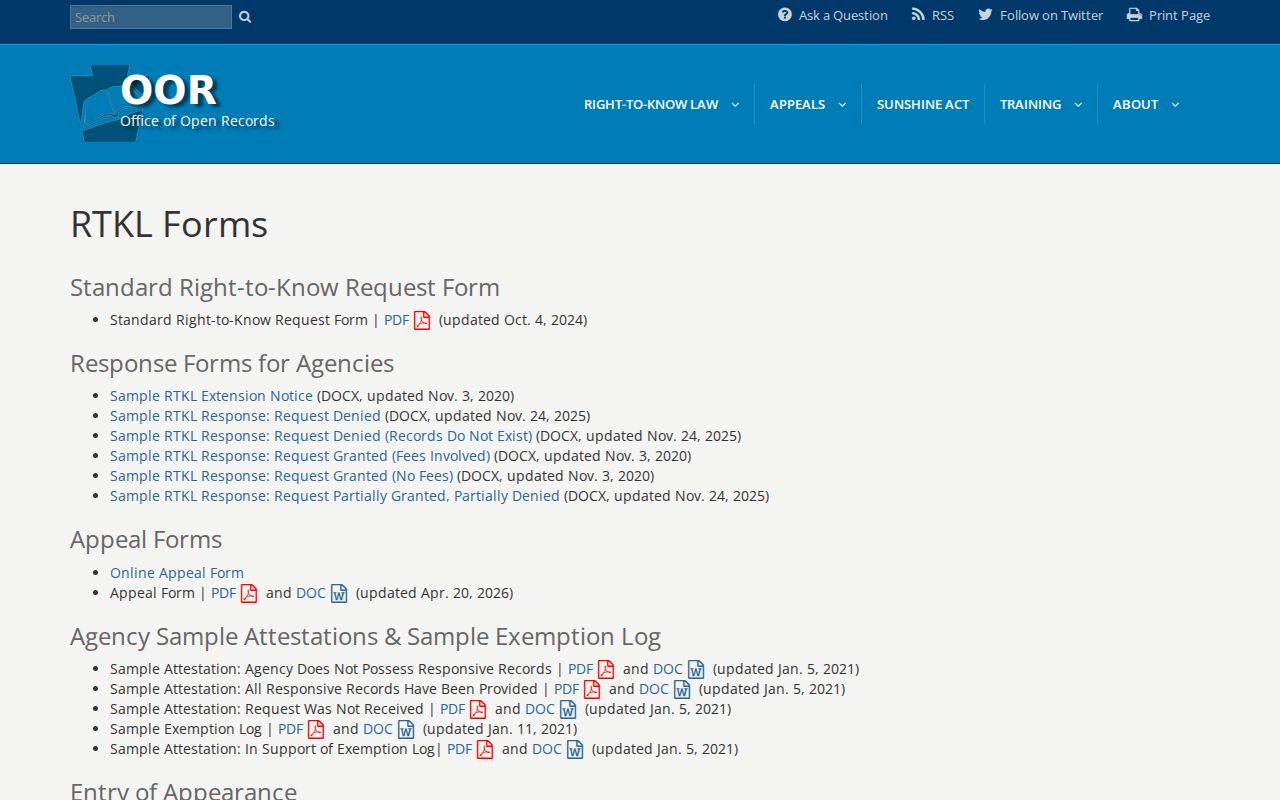
The form is a useful prompt to request a defined existing record, rather than a broad search for personal information.
Bristol Township Resident Privacy Lines
Public access is never permission to expose protected information or target a person. RTKL Section 706 requires redaction of protected material when the remainder can be released. The state identifies Social Security numbers, driver-license numbers, financial and medical information, personal telephone and email fields, and protected minor information among common protected categories. Court policy, a sealing order, or a record-specific law can impose further limits. A missing result may reflect a lawful protection rather than an error.
Pennsylvania’s Address Confidentiality Program provides a substitute address on specified government records for qualifying participants, including voter registration. It is administered through the Office of Victim Advocate and is part of a safety plan. Do not attempt to infer a protected location from a substitute or absent address. Pennsylvania motor-vehicle records also have separate statutory controls, and a license plate alone does not disclose ownership through a general public lookup.
Use records lawfully. Bristol Township resident records may support family history, an estate question, civic research, or a property concern. Do not use any source to stalk, threaten, harass, impersonate, or harm another person.
Bristol Township Postal Place Names
County address-point data associates eight ZIP codes with Bristol Township: 19007, 19021, 19030, 19047, and 19054 through 19057. Several are Levittown postal labels, and the smallest Langhorne and Fairless Hills slices make broad ZIP assumptions unreliable. A ZIP city name is a mailing convention, not a municipal boundary. The county property form’s municipality control and an exact street address provide a better way to test whether an entry belongs in Bristol Township.
For one mailing address, use the USPS ZIP Code Lookup rather than guessing from a nearby development or a directory title. The result helps confirm a postal assignment. It does not return resident or parcel information. Searches in archival catalogs should also try Bristol Township, Bristol, Levittown, Croydon, Fairless Hills, Newportville, and Edgely separately, then reconcile them to the actual address and custodian.
Historic Bristol Township Resident Directories
Grundy Library’s Bristol History collection is the strongest nearby historical shelf, but it must be used with its geographic label in mind. Its digitized Bristol directory collection contains twelve intermittent Bristol Borough volumes from 1871 through 1954. The library also identifies city directories, cemetery transcriptions, high-school yearbooks, and the Bucks County Courier Times on microfilm from 1911 through December 2023, with online coverage from November 2002 forward. These are useful Bristol Township resident leads only after the street, neighborhood, and year are checked.
Grundy is at 680 Radcliffe Street in Bristol Borough and publishes service hours of Monday through Wednesday, 10 to 8, and Thursday through Saturday, 10 to 4. Its holdings cover Bristol Borough and surrounding areas rather than every Township development. Pair an intermittent directory date with a county deed, a census release, a probate entry, or a local newspaper notice. The full collection-by-collection method belongs on the Bristol Township city directory page.
Bristol Township Paper Record Shift
Bucks County’s title system shows how access can span several media. The Recorder holds land records from 1684 to the present. LANDEX reports Bucks data and index availability from 1980 forward and images from 1684 forward, while historic index-book research remains material for older names. New recordings stopped using book-and-page citations on July 1, 2012 in favor of instrument numbers. That is a citation change, not a break in custody.
The Township’s 2026 budget also describes Building and Planning work to convert historic paper files held in carousels and basement storage to electronic or paperless access. It does not mean every older permit can be searched online. Ask Planning whether a particular address file has been converted, then use the Township request route if an existing public file is needed. The result is a Bristol Township records trail that may move from a portal to an index book, microfilm, archive staff, or a records counter.
Note: The research did not confirm a local courthouse fire, flood, or broad record loss, so no destruction claim should be assumed.
Bristol Township State Registry Limits
Some statewide public systems serve a safety or custody purpose, not a general resident search. The Pennsylvania DOC locator accepts a last name or inmate number and says it updates daily, but it excludes county facilities and other-state incarceration. Its data can include self-reported information that the state has not independently verified. Bucks County’s Department of Corrections is the local custody contact because the research did not identify an official public county name-search roster.
The Pennsylvania State Police Megan’s Law public search includes ZIP and radius routes and requires acceptance of its terms. Its public-protection purpose and explicit anti-harassment warning matter. A registry hit or a location result is not a substitute for checking the current state screen, reading the terms, and respecting every legal limit. The screenshot below shows the official entry path for a narrowly defined public safety lookup.
Use the Pennsylvania State Police Megan’s Law search only under its public-protection terms.
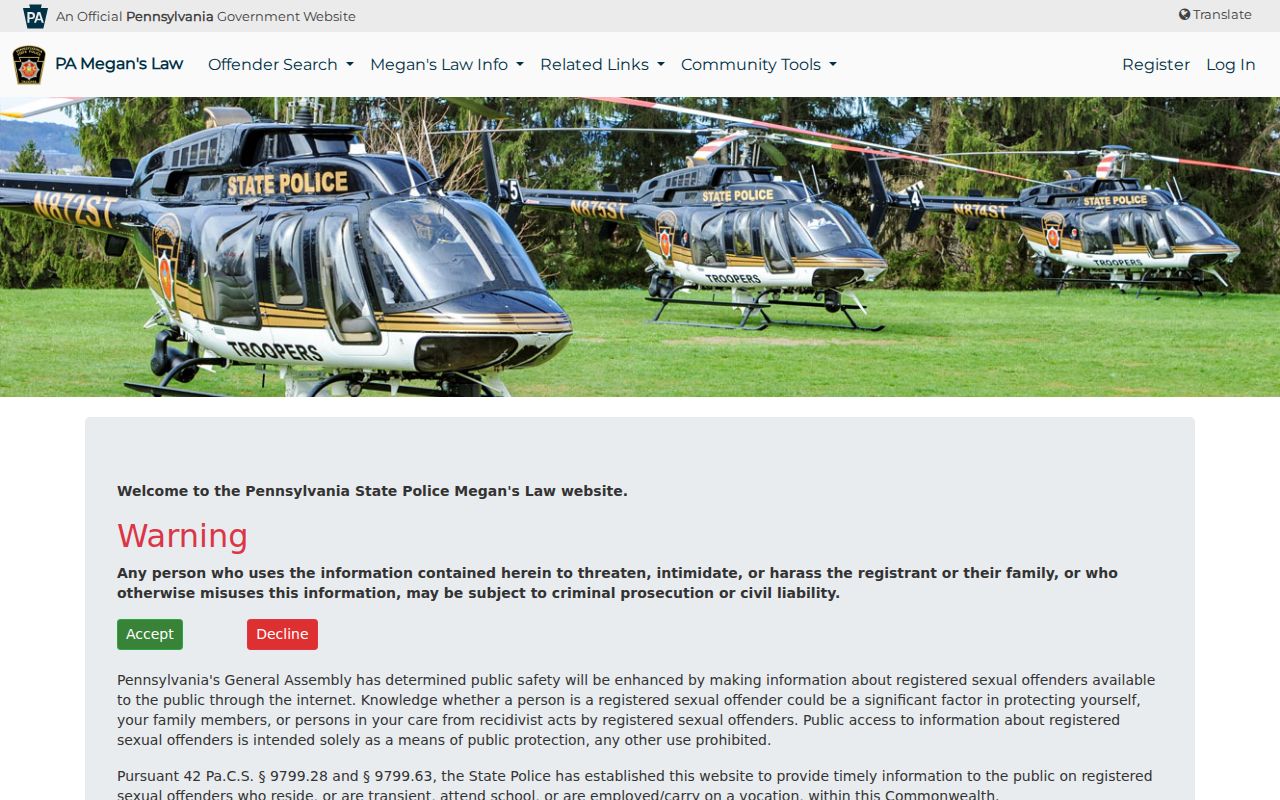
The official entry screen underscores that statewide registries have their own purpose, scope, terms, and safety warnings.